
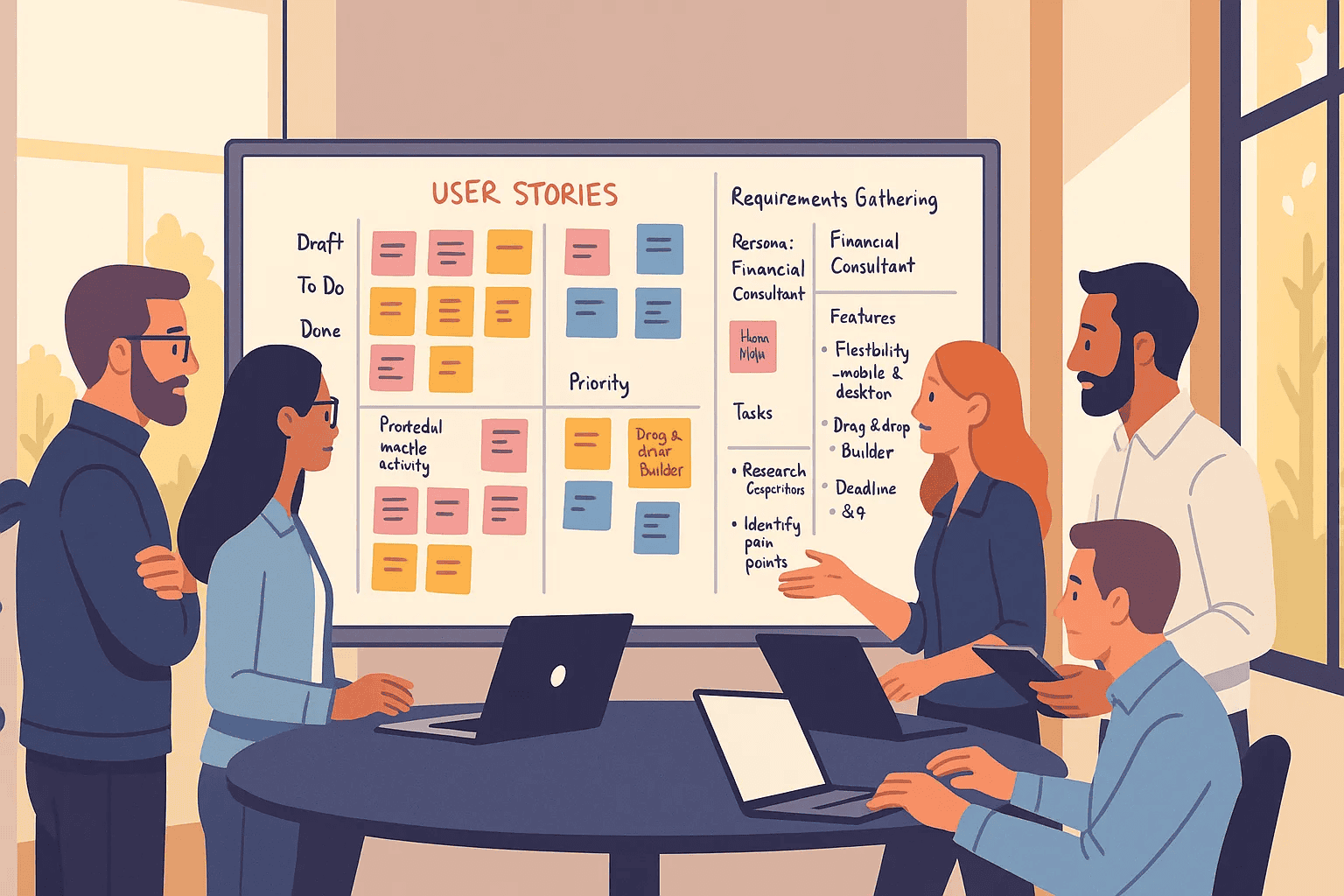
The Pain Points of Traditional User Story Creation
User stories follow a simple format: “As a user, I want functionality so that benefit. ” Yet, simplicity on paper doesn’t translate to simplicity in practice.
Common challenges include:
- Vague Stakeholder Input: Stakeholders may say, “I want a better dashboard,” without specifying what “better” means.
- Time-Intensive Refinement: BAs spend hours rephrasing and clarifying stories to meet acceptance criteria.
- Missed Perspectives: Implicit needs or edge cases often go unnoticed, leading to incomplete requirements.
- Prioritization Struggles: Teams struggle to align user stories with business goals, causing scope creep.
Industry data underscores the stakes: 60% of agile project failures are linked to poorly defined requirements, including weak user stories. In 2025, with software projects demanding faster delivery and hyper-personalized user experiences, these inefficiencies are no longer sustainable. Generative AI offers a smarter way forward, empowering teams to craft user stories that are precise, actionable, and aligned with business objectives.
How Generative AI Supercharges User Story Creation
Generative AI, powered by advanced models like ChatGPT, Google’s Gemini, or Anthropic’s Claude, leverages natural language processing (NLP) and machine learning to automate and enhance user story creation. Here’s how its transforming agile requirement gathering in 2025:
1. Automated Drafting of User Stories
Generative AI can instantly convert stakeholder input into well-structured user stories. By analyzing interview transcripts, emails, or workshop notes, AI tools generate drafts in the standard format, complete with clear roles, functionalities, and benefits. For example, a stakeholder’s comment like, “Customers need easier access to their order history,” can be transformed into: “As a customer, I want to view my order history in one click so that I can track past purchases effortlessly.”
2. Refining and Enhancing Clarity
AI doesn’t just draft it polishes. Generative models analyze user stories for ambiguity, jargon, or missing details, suggesting improvements. For instance, if a story reads, “As a user, I want a fast app,” AI might recommend: “As a user, I want the app to load in under two seconds so that I can access features quickly.” Tools like Jira’s AI plugins also propose acceptance criteria, ensuring stories are testable.
3. Uncovering Implicit Needs
Stakeholders often omit critical details, assuming they’re obvious. Generative AI excels at identifying these implicit needs by cross-referencing input with historical project data or industry benchmarks. For example, an AI tool might suggest adding accessibility features to a user story for a public-facing app, based on compliance trends.
4. Prioritizing User Stories with Data-Driven Insights
Generative AI can rank user stories based on business value, user impact, or technical feasibility. By integrating with project management tools like Trello or Asana, AI analyzes factors like customer feedback, market trends, or development costs to suggest prioritization. This ensures teams focus on high-impact features first.
Why Generative AI Matters for Agile Teams in 2025
The adoption of generative AI for user story creation is reshaping agile workflows for several reasons:
- Speed: AI cuts user story drafting and refinement time by up to 50%, enabling faster sprint planning.
- Accuracy: AI reduces human error and bias, producing stories that are clear and aligned with business goals.
- Scalability: AI handles large volumes of stakeholder input, ideal for complex projects or distributed teams in hybrid work settings.
- Customer Focus: AI ensures user stories reflect consumer demands for personalised experiences, with 70% of users expecting tailored solutions.
Top Generative AI Tools for User Stories in 2025
Here are some leading tools to explore for AI-powered user story creation:
- Jira AI: Generates and refines user stories within agile workflows, integrating with sprint planning.
- ChatGPT Enterprise: Customizable for drafting stories from stakeholder input, with NLP capabilities.
- ClickUp AI: Automates story creation and prioritization for agile project management.
- Miro AI: Supports collaborative story mapping with AI-driven suggestions.
How to Get Started with AI-Powered User Stories
Ready to boost your agile requirement gathering? Follow these steps:
- Identify Pain Points: Pinpoint where user story creation slows your team (e.g., drafting or prioritization).
- Select a Tool: Start with an accessible tool like ClickUp AI or Jira AI for seamless integration.
- Train Your Team: Educate BAs and product owners on using AI as a collaborative tool.
- Run a Pilot: Test AI on a single sprint to measure time savings and story quality.
- Refine and Scale: Use feedback to improve AI outputs and expand to larger projects.
The Future of User Stories in Agile
In 2025, generative AI is not just enhancing user stories—its redefining agile requirement gathering. By automating drafting, refining clarity, uncovering hidden needs, and prioritizing effectively, AI empowers teams to deliver software that meets user and business expectations. As AI models grow more sophisticated, we can expect features like real-time story generation during meetings or predictive story mapping for entire product roadmaps.
For agile teams, the takeaway is simple: embrace generative AI to stay competitive. Whether you’re building a startup’s MVP or an enterprise’s complex system, smarter user stories powered by AI are your ticket to faster, better, and more customer-centric software.